
State Law ESSB 5184 - Parking Reform
New state parking law: What it means for Renton
Renton must update its parking rules
In 2025, the Washington State Legislature adopted the Parking Reform and Modernization Act (ESSB 5184). The law requires cities with more than 50,000 residents to reduce certain minimum off-street parking requirements. This will include Renton (population: roughly 109,700).
These updates are mandatory under state law and must be implemented by January 2027.
What the state law requires
The law limits the amount of parking that cities are allowed to require. It also establishes several situations in which cities may not have any minimum parking requirements. Renton must revise its development regulations to match the following standards. These changes do not affect parking requirements under the Americans with Disabilities Act (ADA), which remain in effect. Changes include: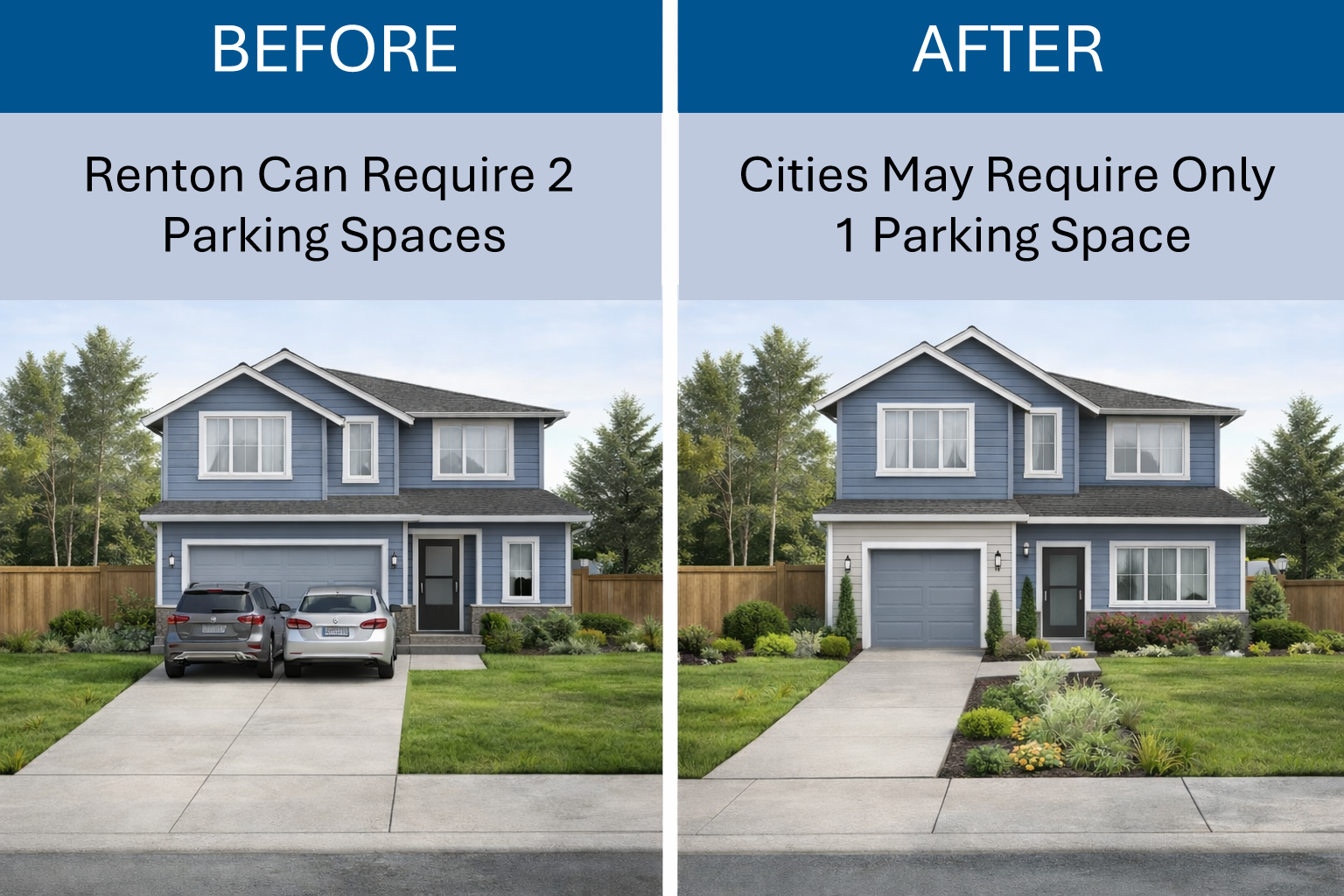
- Maximum parking that cities can require:
- Multifamily housing: up to 0.5 spaces per dwelling unit.
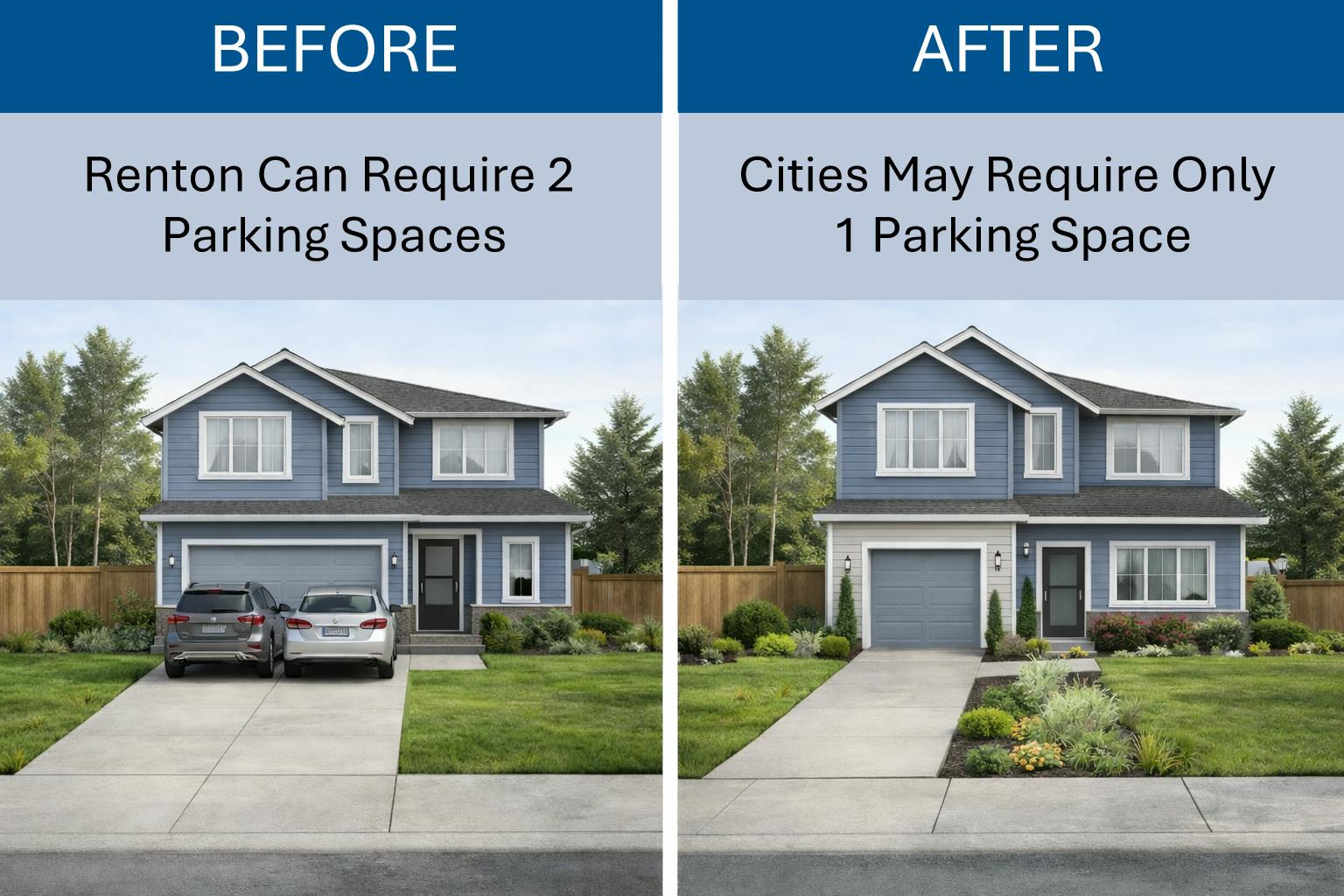
- Single-family homes: up to 1 space per home.
- Commercial space: up to 2 spaces per 1,000 sq. ft.
- Cities cannot require parking for the following:
- Homes under 1,200 sq. ft.
- Commercial uses (retail, office, wholesale, general merchandise, and food services) under 3,000 sq. ft.
- Affordable housing.
- Senior housing.
- Licensed childcare centers.
- Ground-floor commercial uses in mixed-use buildings.
- Projects converting from non-residential to residential (or to commercial).
What this means for future development in Renton
Renton meets the state’s population target; therefore, the city must update its residential and commercial parking standards so they align with all requirements of ESSB 5184. These updates must be adopted by January 2027. Once adopted:
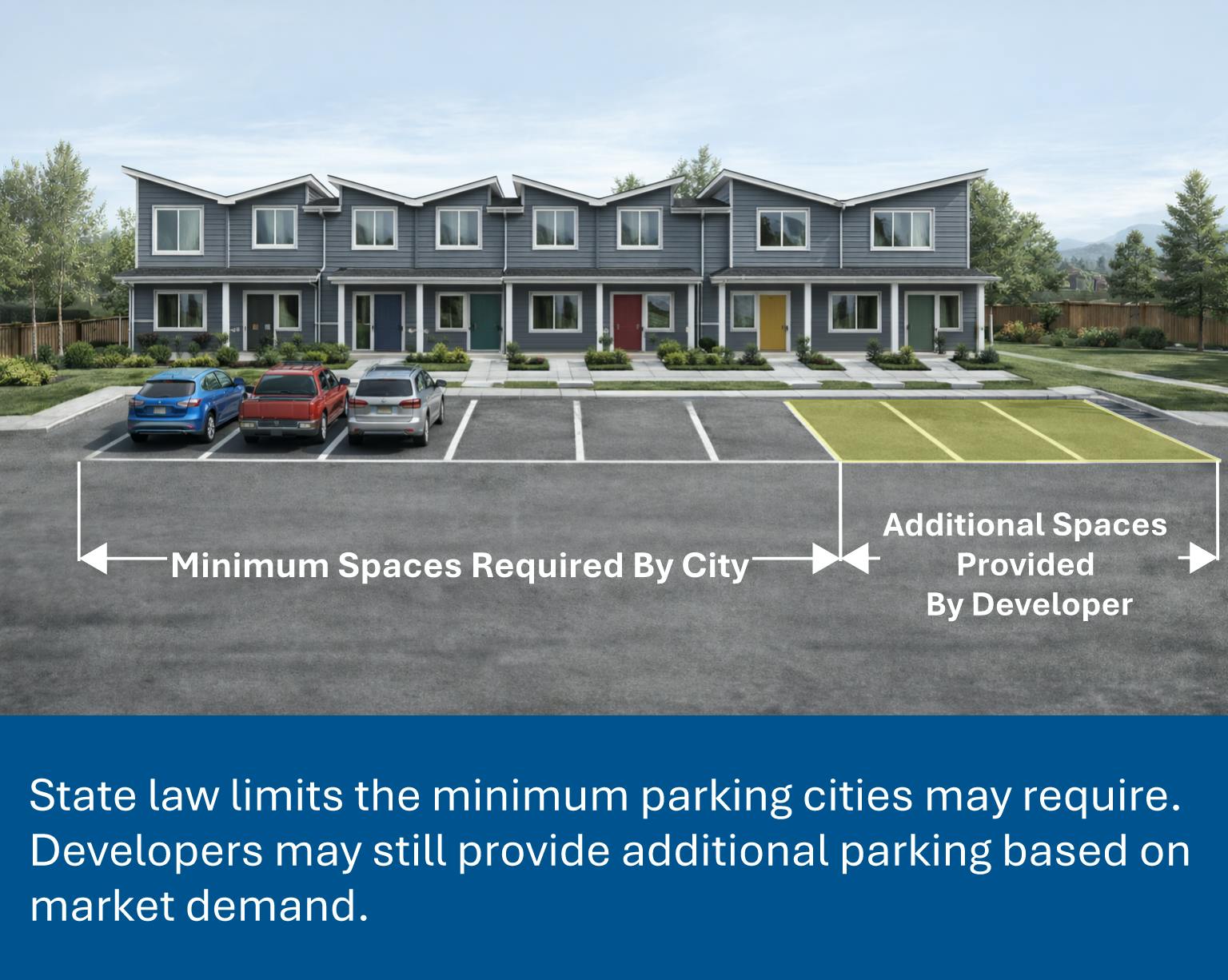
- The city cannot require more parking than the state allows.
- Developers may choose to build more parking than required, based on project needs and market demand.
- Parking requirements will still vary depending on project size, use, and the standards established by the state.
The city's role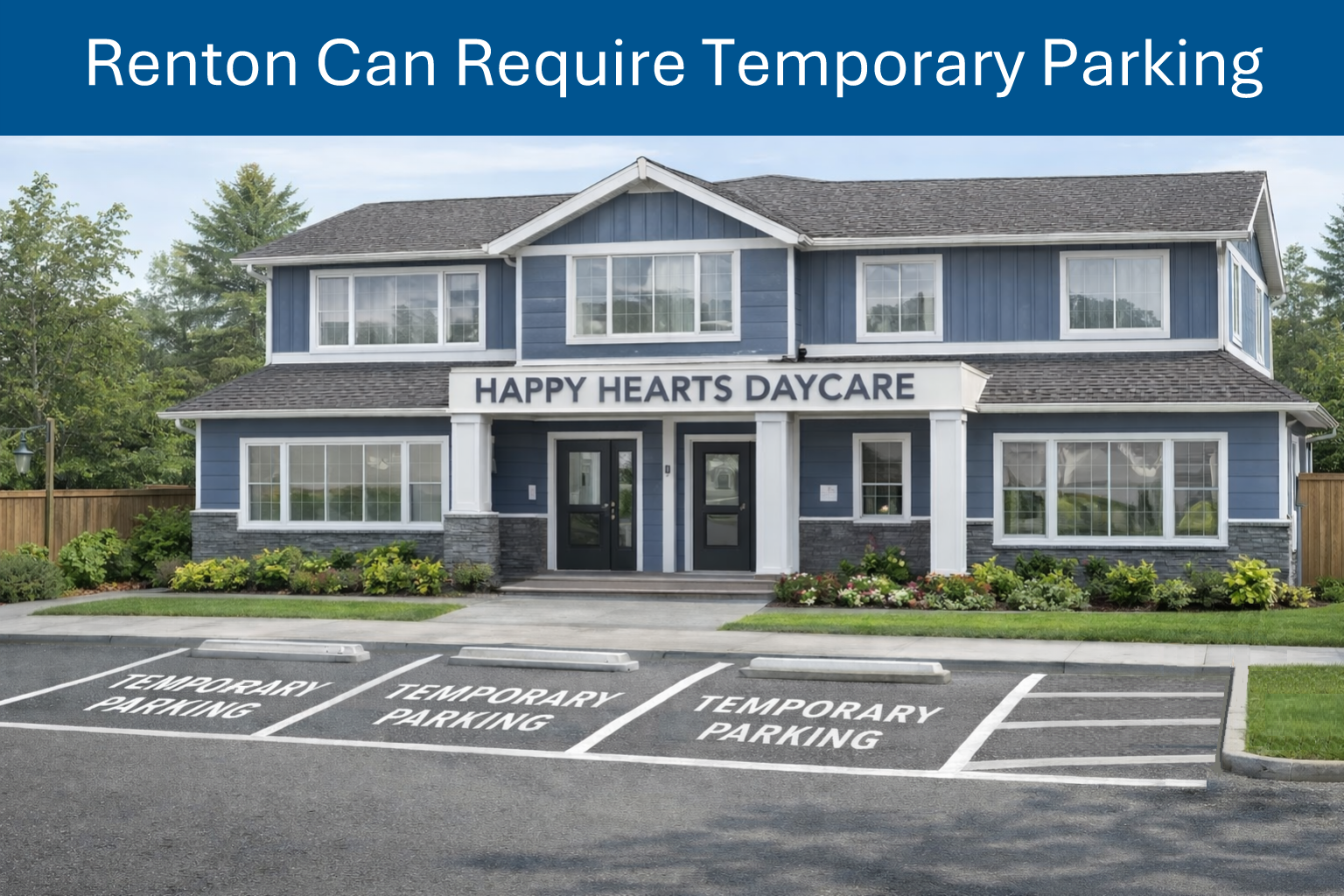
Renton’s role is limited to:
- Updating the Renton Municipal Code to comply with state law.
- Reviewing applications based on the new standards.
- Maintaining ADA compliance.
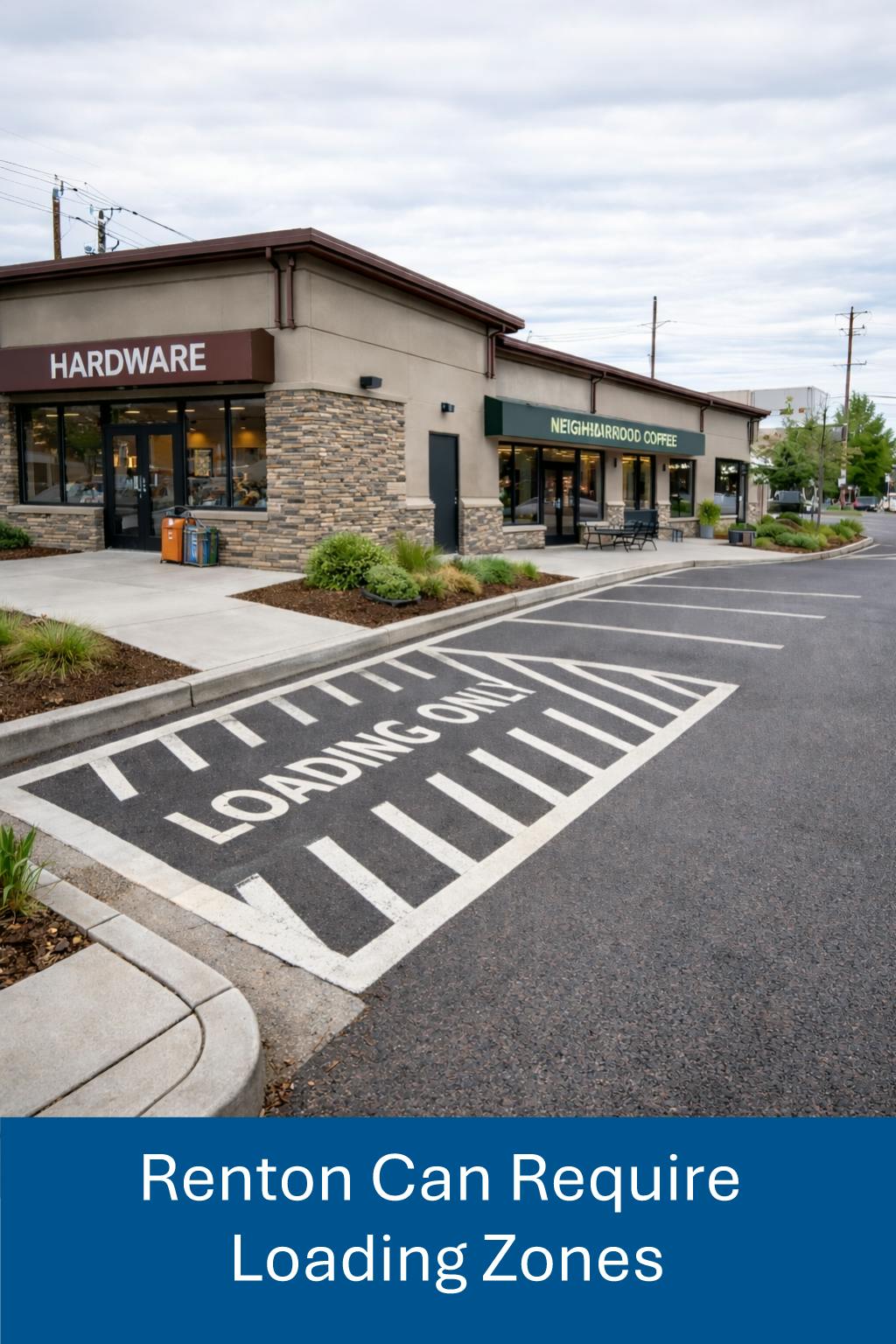
- Evaluating opportunities—within state constraints—to address parking needs through time-limited parking spaces and loading zones for deliveries and multifamily move-in/move-out activities.
We want to hear from you
Although the city must adopt these state-required changes, community perspectives are important to help us understand local concerns and guide implementation within the limits of state law.
These questions can help inform future parking regulations.
All images are illustrative only and do not depict compliance with parking, building design, or other development standards.
New state parking law: What it means for Renton
Renton must update its parking rules
In 2025, the Washington State Legislature adopted the Parking Reform and Modernization Act (ESSB 5184). The law requires cities with more than 50,000 residents to reduce certain minimum off-street parking requirements. This will include Renton (population: roughly 109,700).
These updates are mandatory under state law and must be implemented by January 2027.
What the state law requires
The law limits the amount of parking that cities are allowed to require. It also establishes several situations in which cities may not have any minimum parking requirements. Renton must revise its development regulations to match the following standards. These changes do not affect parking requirements under the Americans with Disabilities Act (ADA), which remain in effect. Changes include:
- Maximum parking that cities can require:
- Multifamily housing: up to 0.5 spaces per dwelling unit.
- Single-family homes: up to 1 space per home.
- Commercial space: up to 2 spaces per 1,000 sq. ft.
- Cities cannot require parking for the following:
- Homes under 1,200 sq. ft.
- Commercial uses (retail, office, wholesale, general merchandise, and food services) under 3,000 sq. ft.
- Affordable housing.
- Senior housing.
- Licensed childcare centers.
- Ground-floor commercial uses in mixed-use buildings.
- Projects converting from non-residential to residential (or to commercial).
What this means for future development in Renton
Renton meets the state’s population target; therefore, the city must update its residential and commercial parking standards so they align with all requirements of ESSB 5184. These updates must be adopted by January 2027. Once adopted:
- The city cannot require more parking than the state allows.
- Developers may choose to build more parking than required, based on project needs and market demand.
- Parking requirements will still vary depending on project size, use, and the standards established by the state.
The city's role
Renton’s role is limited to:
- Updating the Renton Municipal Code to comply with state law.
- Reviewing applications based on the new standards.
- Maintaining ADA compliance.
- Evaluating opportunities—within state constraints—to address parking needs through time-limited parking spaces and loading zones for deliveries and multifamily move-in/move-out activities.
We want to hear from you
Although the city must adopt these state-required changes, community perspectives are important to help us understand local concerns and guide implementation within the limits of state law.
These questions can help inform future parking regulations.
All images are illustrative only and do not depict compliance with parking, building design, or other development standards.
Ask questions or add comments about the Parking Reform and Modernization Act (ESSB 5184)
-
Share How about neighborhood that have several cars in their driveways none of them mobile which is unsightly? What is Renton doing with those? on Facebook Share How about neighborhood that have several cars in their driveways none of them mobile which is unsightly? What is Renton doing with those? on X (formerly Twitter) Share How about neighborhood that have several cars in their driveways none of them mobile which is unsightly? What is Renton doing with those? on Linkedin Email How about neighborhood that have several cars in their driveways none of them mobile which is unsightly? What is Renton doing with those? link
How about neighborhood that have several cars in their driveways none of them mobile which is unsightly? What is Renton doing with those?
Carmi asked 4 months agoThank you for your question.
Issues related to inoperable vehicles, property maintenance, and nuisance conditions are regulated separately from the City’s parking requirements for new development. Existing City codes regarding abandoned or inoperable vehicles remain in effect and are not changed by ESSB 5184.
Concerns related to specific properties or code violations can be reported directly to the City’s Code Enforcement team for review. The quickest way to submit a report and track its progress is by using the Renton Responds online service portal.
-
Share There's alrwady too little parking! Finding parking in this city is a nightmare. Why on earth are you doing this? It benefits nobody. Where are we supposed to park? on Facebook Share There's alrwady too little parking! Finding parking in this city is a nightmare. Why on earth are you doing this? It benefits nobody. Where are we supposed to park? on X (formerly Twitter) Share There's alrwady too little parking! Finding parking in this city is a nightmare. Why on earth are you doing this? It benefits nobody. Where are we supposed to park? on Linkedin Email There's alrwady too little parking! Finding parking in this city is a nightmare. Why on earth are you doing this? It benefits nobody. Where are we supposed to park? link
There's alrwady too little parking! Finding parking in this city is a nightmare. Why on earth are you doing this? It benefits nobody. Where are we supposed to park?
Natalia asked 5 months agoHi Natalia,
Thank you for sharing your concerns regarding parking availability in Renton. We recognize that parking access is an important issue for many residents, particularly in areas where on-street parking is already limited.
ESSB 5184 is a state law adopted by the Washington State Legislature that requires cities above a certain population threshold, including Renton, to revise portions of their parking regulations by January 2027. The law limits the amount of parking cities may require for certain types of development and prohibits minimum parking requirements in specific situations identified by the state.
While the City is required to comply with these state requirements, developers may still choose to provide parking based on project needs, market demand, and financing considerations. The City will also continue evaluating tools that remain available under state law to help address parking access, operations, and safety where feasible.
Feedback such as yours helps staff and the Planning Commission better understand how residents are experiencing parking conditions throughout the city as implementation moves forward.
-
Share I am largely unconcerned about this change. However will the city advocate for better transit services from the county and sound transit to allow people to have less need of a car. For example will there be any changes to link the landing transit hub with the upcoming BRT station at NE 44th on Facebook Share I am largely unconcerned about this change. However will the city advocate for better transit services from the county and sound transit to allow people to have less need of a car. For example will there be any changes to link the landing transit hub with the upcoming BRT station at NE 44th on X (formerly Twitter) Share I am largely unconcerned about this change. However will the city advocate for better transit services from the county and sound transit to allow people to have less need of a car. For example will there be any changes to link the landing transit hub with the upcoming BRT station at NE 44th on Linkedin Email I am largely unconcerned about this change. However will the city advocate for better transit services from the county and sound transit to allow people to have less need of a car. For example will there be any changes to link the landing transit hub with the upcoming BRT station at NE 44th link
I am largely unconcerned about this change. However will the city advocate for better transit services from the county and sound transit to allow people to have less need of a car. For example will there be any changes to link the landing transit hub with the upcoming BRT station at NE 44th
Mathew asked 5 months agoThank you for sharing your perspective and your interest in improved transit connectivity.
While ESSB 5184 specifically addresses municipal parking regulations, the City continues to coordinate regularly with regional transit agencies, including King County Metro and Sound Transit. The City advocates for Renton’s interests within long-range transportation planning, local service connections, and access to upcoming regional transit corridors and stations.
As regional transit projects and service updates progress, community feedback regarding connectivity between commercial areas, neighborhoods, and regional facilities is valuable. Residents can track project statuses, view service updates, and find opportunities to comment directly by visiting the Sound Transit System Expansion page at soundtransit.org/system-expansion and the King County Metro website at kingcounty.gov/metro.
Input like yours helps inform broader conversations with transit partners as the City evaluates how transportation options may continue to evolve alongside changes to state development laws.
-
Share Will there be a limit to how many vehicles a resident can have in the driveway and on the street. I live on ne 26th Pl for 21 years. One person rented out their house and they have up to seven vehicles in their driveway and in front of the house. When they moved in they had so many vehicles they were parking three cars in front of my house. I had to purchase an extra vehicle to park in front of my house so they couldn’t park there. Also next to the fence is a fire lane and they usually have two vehicles by the fence. This is very annoying and inconsiderate for the neighbors that are home owners. These are supposed to be single family homes. They must have at least five adults living there. I hope that any new regulations will take care of this. on Facebook Share Will there be a limit to how many vehicles a resident can have in the driveway and on the street. I live on ne 26th Pl for 21 years. One person rented out their house and they have up to seven vehicles in their driveway and in front of the house. When they moved in they had so many vehicles they were parking three cars in front of my house. I had to purchase an extra vehicle to park in front of my house so they couldn’t park there. Also next to the fence is a fire lane and they usually have two vehicles by the fence. This is very annoying and inconsiderate for the neighbors that are home owners. These are supposed to be single family homes. They must have at least five adults living there. I hope that any new regulations will take care of this. on X (formerly Twitter) Share Will there be a limit to how many vehicles a resident can have in the driveway and on the street. I live on ne 26th Pl for 21 years. One person rented out their house and they have up to seven vehicles in their driveway and in front of the house. When they moved in they had so many vehicles they were parking three cars in front of my house. I had to purchase an extra vehicle to park in front of my house so they couldn’t park there. Also next to the fence is a fire lane and they usually have two vehicles by the fence. This is very annoying and inconsiderate for the neighbors that are home owners. These are supposed to be single family homes. They must have at least five adults living there. I hope that any new regulations will take care of this. on Linkedin Email Will there be a limit to how many vehicles a resident can have in the driveway and on the street. I live on ne 26th Pl for 21 years. One person rented out their house and they have up to seven vehicles in their driveway and in front of the house. When they moved in they had so many vehicles they were parking three cars in front of my house. I had to purchase an extra vehicle to park in front of my house so they couldn’t park there. Also next to the fence is a fire lane and they usually have two vehicles by the fence. This is very annoying and inconsiderate for the neighbors that are home owners. These are supposed to be single family homes. They must have at least five adults living there. I hope that any new regulations will take care of this. link
Will there be a limit to how many vehicles a resident can have in the driveway and on the street. I live on ne 26th Pl for 21 years. One person rented out their house and they have up to seven vehicles in their driveway and in front of the house. When they moved in they had so many vehicles they were parking three cars in front of my house. I had to purchase an extra vehicle to park in front of my house so they couldn’t park there. Also next to the fence is a fire lane and they usually have two vehicles by the fence. This is very annoying and inconsiderate for the neighbors that are home owners. These are supposed to be single family homes. They must have at least five adults living there. I hope that any new regulations will take care of this.
WilliamWinner asked 5 months agoThank you for sharing these details regarding parking conditions in your neighborhood.
The issues you described regarding the number of vehicles parked at a residence, parking near fire lanes, and vehicle placement are generally addressed through existing City code provisions and code enforcement processes rather than through ESSB 5184 itself. For example, Renton Municipal Code, Section 4-4-085, includes standards related to the maximum number of vehicles permitted on residential lots, parking location requirements, and obstruction or safety concerns.
ESSB 5184 specifically addresses the amount of off-street parking the City may require for new development, but it does not eliminate existing regulations related to public safety, fire access, vehicle operability, or other nuisance-related parking standards. Comments such as yours are still helpful as the City evaluates how parking and neighborhood conditions may continue to evolve during implementation of the new state requirements.
-
Share Agree with Stephen... "The City should challenge this in Court. This is a clear overreach of State government in an area where the State has no vested interest. I currently live in an area (Renton Hills) where many of the home were built in the 50's and 60's and are under 1200 sq. ft. If there was no requirement for parking, the streets would be a mess with cars parked everywhere. In my area, the bus route was discontinued during COVID and the change was made permanent; the nearest bus stop is now almost a mile away. The results is more cars parked on the streets. Cities should be allowed to enact development codes that are consistent with the vision of the community, not what the State thinks the vision should be." on Facebook Share Agree with Stephen... "The City should challenge this in Court. This is a clear overreach of State government in an area where the State has no vested interest. I currently live in an area (Renton Hills) where many of the home were built in the 50's and 60's and are under 1200 sq. ft. If there was no requirement for parking, the streets would be a mess with cars parked everywhere. In my area, the bus route was discontinued during COVID and the change was made permanent; the nearest bus stop is now almost a mile away. The results is more cars parked on the streets. Cities should be allowed to enact development codes that are consistent with the vision of the community, not what the State thinks the vision should be." on X (formerly Twitter) Share Agree with Stephen... "The City should challenge this in Court. This is a clear overreach of State government in an area where the State has no vested interest. I currently live in an area (Renton Hills) where many of the home were built in the 50's and 60's and are under 1200 sq. ft. If there was no requirement for parking, the streets would be a mess with cars parked everywhere. In my area, the bus route was discontinued during COVID and the change was made permanent; the nearest bus stop is now almost a mile away. The results is more cars parked on the streets. Cities should be allowed to enact development codes that are consistent with the vision of the community, not what the State thinks the vision should be." on Linkedin Email Agree with Stephen... "The City should challenge this in Court. This is a clear overreach of State government in an area where the State has no vested interest. I currently live in an area (Renton Hills) where many of the home were built in the 50's and 60's and are under 1200 sq. ft. If there was no requirement for parking, the streets would be a mess with cars parked everywhere. In my area, the bus route was discontinued during COVID and the change was made permanent; the nearest bus stop is now almost a mile away. The results is more cars parked on the streets. Cities should be allowed to enact development codes that are consistent with the vision of the community, not what the State thinks the vision should be." link
Agree with Stephen... "The City should challenge this in Court. This is a clear overreach of State government in an area where the State has no vested interest. I currently live in an area (Renton Hills) where many of the home were built in the 50's and 60's and are under 1200 sq. ft. If there was no requirement for parking, the streets would be a mess with cars parked everywhere. In my area, the bus route was discontinued during COVID and the change was made permanent; the nearest bus stop is now almost a mile away. The results is more cars parked on the streets. Cities should be allowed to enact development codes that are consistent with the vision of the community, not what the State thinks the vision should be."
Lynipers asked 5 months agoThank you for adding your voice to the discussion and echoing these concerns.
At this time, the City’s administrative focus is ensuring Renton complies with the state-mandated implementation deadline. As part of that process, the City will continue evaluating opportunities that remain available under state law to help address parking and access needs where feasible, while also monitoring future state guidance, legislative revisions, and implementation issues being raised by jurisdictions across Washington.
As noted in response to Stephen’s comment, while the law limits what the City may require, it does not prevent developers from providing parking based on market demand, nor does it prevent lenders or financing institutions from establishing their own parking expectations for projects. Hearing that multiple residents share these concerns regarding specific neighborhoods helps staff and the Planning Commission better understand how these changes may affect different areas of Renton during the local implementation process.
-
Share While I understand the intent behind state law requirements, it is already becoming increasingly difficult to find street parking in downtown Renton. Many residents still rely on personal vehicles, and current public transportation options are not efficient or convenient enough to meet demand. Finding downtown street parking is already a challenge. The parking garage is not a practical alternative, as it feels unsafe and does not accommodate over-height vehicles. In addition, higher-density housing and multiple adult residents per household have led to more vehicles per household, further straining limited parking and raising safety concerns. Streets in my neighborhood that were once clear and safe for walking, biking, and other activities (and notably lack sidewalks) are now often congested with parked cars. This reduces visibility and can make it difficult - and at times unsafe - to enter and exit driveways. The situation is further complicated by minors on e-bikes and e-scooters who dart between parked vehicles, transitioning quickly from sidewalks to the street without looking for traffic, adding to already reduced visibility and overall safety risks. The downtown core should remain accessible to all Renton residents, not just those who live nearby. Ample and accessible street parking is essential to maintaining quality of life in the city. Having to compete for limited street parking directly in front of our own residences also contributes to growing frustration among neighbors. Please avoid policies that discourage or penalize residents who rely on personal vehicles, and instead strive for balanced solutions that support access for everyone. Thank you for your consideration. on Facebook Share While I understand the intent behind state law requirements, it is already becoming increasingly difficult to find street parking in downtown Renton. Many residents still rely on personal vehicles, and current public transportation options are not efficient or convenient enough to meet demand. Finding downtown street parking is already a challenge. The parking garage is not a practical alternative, as it feels unsafe and does not accommodate over-height vehicles. In addition, higher-density housing and multiple adult residents per household have led to more vehicles per household, further straining limited parking and raising safety concerns. Streets in my neighborhood that were once clear and safe for walking, biking, and other activities (and notably lack sidewalks) are now often congested with parked cars. This reduces visibility and can make it difficult - and at times unsafe - to enter and exit driveways. The situation is further complicated by minors on e-bikes and e-scooters who dart between parked vehicles, transitioning quickly from sidewalks to the street without looking for traffic, adding to already reduced visibility and overall safety risks. The downtown core should remain accessible to all Renton residents, not just those who live nearby. Ample and accessible street parking is essential to maintaining quality of life in the city. Having to compete for limited street parking directly in front of our own residences also contributes to growing frustration among neighbors. Please avoid policies that discourage or penalize residents who rely on personal vehicles, and instead strive for balanced solutions that support access for everyone. Thank you for your consideration. on X (formerly Twitter) Share While I understand the intent behind state law requirements, it is already becoming increasingly difficult to find street parking in downtown Renton. Many residents still rely on personal vehicles, and current public transportation options are not efficient or convenient enough to meet demand. Finding downtown street parking is already a challenge. The parking garage is not a practical alternative, as it feels unsafe and does not accommodate over-height vehicles. In addition, higher-density housing and multiple adult residents per household have led to more vehicles per household, further straining limited parking and raising safety concerns. Streets in my neighborhood that were once clear and safe for walking, biking, and other activities (and notably lack sidewalks) are now often congested with parked cars. This reduces visibility and can make it difficult - and at times unsafe - to enter and exit driveways. The situation is further complicated by minors on e-bikes and e-scooters who dart between parked vehicles, transitioning quickly from sidewalks to the street without looking for traffic, adding to already reduced visibility and overall safety risks. The downtown core should remain accessible to all Renton residents, not just those who live nearby. Ample and accessible street parking is essential to maintaining quality of life in the city. Having to compete for limited street parking directly in front of our own residences also contributes to growing frustration among neighbors. Please avoid policies that discourage or penalize residents who rely on personal vehicles, and instead strive for balanced solutions that support access for everyone. Thank you for your consideration. on Linkedin Email While I understand the intent behind state law requirements, it is already becoming increasingly difficult to find street parking in downtown Renton. Many residents still rely on personal vehicles, and current public transportation options are not efficient or convenient enough to meet demand. Finding downtown street parking is already a challenge. The parking garage is not a practical alternative, as it feels unsafe and does not accommodate over-height vehicles. In addition, higher-density housing and multiple adult residents per household have led to more vehicles per household, further straining limited parking and raising safety concerns. Streets in my neighborhood that were once clear and safe for walking, biking, and other activities (and notably lack sidewalks) are now often congested with parked cars. This reduces visibility and can make it difficult - and at times unsafe - to enter and exit driveways. The situation is further complicated by minors on e-bikes and e-scooters who dart between parked vehicles, transitioning quickly from sidewalks to the street without looking for traffic, adding to already reduced visibility and overall safety risks. The downtown core should remain accessible to all Renton residents, not just those who live nearby. Ample and accessible street parking is essential to maintaining quality of life in the city. Having to compete for limited street parking directly in front of our own residences also contributes to growing frustration among neighbors. Please avoid policies that discourage or penalize residents who rely on personal vehicles, and instead strive for balanced solutions that support access for everyone. Thank you for your consideration. link
While I understand the intent behind state law requirements, it is already becoming increasingly difficult to find street parking in downtown Renton. Many residents still rely on personal vehicles, and current public transportation options are not efficient or convenient enough to meet demand. Finding downtown street parking is already a challenge. The parking garage is not a practical alternative, as it feels unsafe and does not accommodate over-height vehicles. In addition, higher-density housing and multiple adult residents per household have led to more vehicles per household, further straining limited parking and raising safety concerns. Streets in my neighborhood that were once clear and safe for walking, biking, and other activities (and notably lack sidewalks) are now often congested with parked cars. This reduces visibility and can make it difficult - and at times unsafe - to enter and exit driveways. The situation is further complicated by minors on e-bikes and e-scooters who dart between parked vehicles, transitioning quickly from sidewalks to the street without looking for traffic, adding to already reduced visibility and overall safety risks. The downtown core should remain accessible to all Renton residents, not just those who live nearby. Ample and accessible street parking is essential to maintaining quality of life in the city. Having to compete for limited street parking directly in front of our own residences also contributes to growing frustration among neighbors. Please avoid policies that discourage or penalize residents who rely on personal vehicles, and instead strive for balanced solutions that support access for everyone. Thank you for your consideration.
S.Inks asked 5 months agoThank you for taking the time to share your concerns and experiences regarding parking, neighborhood safety, and access to downtown Renton. Feedback such as this is helpful as the City works through implementation of the new state requirements and better understands the types of concerns community members are experiencing in different parts of the city.
The City understands that many residents continue to rely on personal vehicles and that parking availability and visibility can be important considerations for both neighborhoods and downtown access. While ESSB 5184 limits the amount of parking the City may require for certain developments, developers may still choose to provide additional parking based on project needs and market demand. In many cases, lenders and financing institutions also continue to evaluate parking availability as part of project financing considerations.
As part of implementation, the City will continue evaluating tools that remain available under state law to help address parking operations, access, and safety concerns, including strategies related to curb management, loading, and time-limited parking where appropriate. Community feedback will continue to help inform those discussions as the City works to comply with the new state requirements.
-
Share The City should challenge this in Court. This is a clear overreach of State government in an area where the State has no vested interest. I currently live in an area (Renton Hills) where many of the home were built in the 50's and 60's and are under 1200 sq. ft. If there was no requirement for parking, the streets would be a mess with cars parked everywhere. In my area, the bus route was discontinued during COVID and the change was made permanent; the nearest bus stop is now almost a mile away. The results is more cars parked on the streets. Cities should be allowed to enact development codes that are consistent with the vision of the community, not what the State thinks the vision should be. on Facebook Share The City should challenge this in Court. This is a clear overreach of State government in an area where the State has no vested interest. I currently live in an area (Renton Hills) where many of the home were built in the 50's and 60's and are under 1200 sq. ft. If there was no requirement for parking, the streets would be a mess with cars parked everywhere. In my area, the bus route was discontinued during COVID and the change was made permanent; the nearest bus stop is now almost a mile away. The results is more cars parked on the streets. Cities should be allowed to enact development codes that are consistent with the vision of the community, not what the State thinks the vision should be. on X (formerly Twitter) Share The City should challenge this in Court. This is a clear overreach of State government in an area where the State has no vested interest. I currently live in an area (Renton Hills) where many of the home were built in the 50's and 60's and are under 1200 sq. ft. If there was no requirement for parking, the streets would be a mess with cars parked everywhere. In my area, the bus route was discontinued during COVID and the change was made permanent; the nearest bus stop is now almost a mile away. The results is more cars parked on the streets. Cities should be allowed to enact development codes that are consistent with the vision of the community, not what the State thinks the vision should be. on Linkedin Email The City should challenge this in Court. This is a clear overreach of State government in an area where the State has no vested interest. I currently live in an area (Renton Hills) where many of the home were built in the 50's and 60's and are under 1200 sq. ft. If there was no requirement for parking, the streets would be a mess with cars parked everywhere. In my area, the bus route was discontinued during COVID and the change was made permanent; the nearest bus stop is now almost a mile away. The results is more cars parked on the streets. Cities should be allowed to enact development codes that are consistent with the vision of the community, not what the State thinks the vision should be. link
The City should challenge this in Court. This is a clear overreach of State government in an area where the State has no vested interest. I currently live in an area (Renton Hills) where many of the home were built in the 50's and 60's and are under 1200 sq. ft. If there was no requirement for parking, the streets would be a mess with cars parked everywhere. In my area, the bus route was discontinued during COVID and the change was made permanent; the nearest bus stop is now almost a mile away. The results is more cars parked on the streets. Cities should be allowed to enact development codes that are consistent with the vision of the community, not what the State thinks the vision should be.
Stephen asked 5 months agoThank you for sharing your perspective and providing specific details regarding your neighborhood.
ESSB 5184 is a state law adopted by the Washington State Legislature, and Renton is required to update its development regulations to comply with these standards by January 2027. Currently, the City is focused on the mandatory implementation of this state law.
We understand your concerns regarding local neighborhood characteristics and transit access. While the law limits the City’s ability to mandate parking in certain situations, it does not prevent developers from providing parking based on project needs, market demand, or financing requirements. Local insights like yours are valuable as they help staff and the Planning Commission understand how these state-wide changes may impact different areas of Renton during the implementation process.
-
Share How and why did this become an issue? What was the concern about leaving the parking requirements the way they are now? on Facebook Share How and why did this become an issue? What was the concern about leaving the parking requirements the way they are now? on X (formerly Twitter) Share How and why did this become an issue? What was the concern about leaving the parking requirements the way they are now? on Linkedin Email How and why did this become an issue? What was the concern about leaving the parking requirements the way they are now? link
How and why did this become an issue? What was the concern about leaving the parking requirements the way they are now?
John Nixon asked 5 months agoThank you for your inquiry.
The Washington State Legislature adopted ESSB 5184 as part of an effort to reduce regulatory barriers associated with housing and commercial development. The state determined that, in some cases, existing parking requirements could:
• Increase development costs
• Reduce site flexibility
• Limit the amount or type of housing and commercial space that could be built
As a result, the law places limits on the amount of parking cities may require and establishes situations where minimum parking requirements are no longer allowed. Renton is required to update its regulations to comply with these state standards by January 2027.
-
Share Are there ways that Renton can incentivize additional parking even if we cannot require it? on Facebook Share Are there ways that Renton can incentivize additional parking even if we cannot require it? on X (formerly Twitter) Share Are there ways that Renton can incentivize additional parking even if we cannot require it? on Linkedin Email Are there ways that Renton can incentivize additional parking even if we cannot require it? link
Are there ways that Renton can incentivize additional parking even if we cannot require it?
Jmcfish asked 7 months agoWhile state law now limits the City’s ability to require minimum parking in many cases, the City can still support the provision of parking through voluntary approaches and code flexibility. Some potential approaches include:
- Development Incentives: The City may consider incentives for projects that provide parking even where none is required, such as offering flexibility in other development standards.
- Design Flexibility: The City could allow for more creative building or site design standards to make it easier for developers to include parking where it makes sense for their specific project.
As code updates move forward, the City’s approach is focused on aligning with state requirements while allowing the market to provide parking where demand exists. No specific incentives have been adopted at this time, and all community input will continue to be considered as part of this ongoing process.
-
Senior Planner

Email AWeihs@Rentonwa.gov

-
Project Kick-Off
State Law ESSB 5184 - Parking Reform has finished this stageThis phase includes preparing clear public information, creating outreach materials, and meeting announcements.
-
Public Information & Transparency Outreach
State Law ESSB 5184 - Parking Reform has finished this stageBeginning summer of 2026, staff will share information and answer questions at events. Feedback during this stage will help identify common questions, concerns, and where additional clarification is needed.
-
State Guidance Review
State Law ESSB 5184 - Parking Reform has finished this stageCity staff will evaluate the guidance, confirm required changes to Renton’s development regulations, and begin preparing code language that complies with state requirements.
-
Jurisdictional Review & Technical Analysis
State Law ESSB 5184 - Parking Reform has finished this stageCity staff will review how other cities are implementing ESSB 5184, including code structure, definitions, and best practices for aligning with the state mandate.
This research will support formation of Renton’s draft code revisions and ensure consistency with regional approaches.
-
Presentations to Planning Commission
State Law ESSB 5184 - Parking Reform is currently at this stageCity staff will present recommendations for Planning Commission consideration. The public process will include a staff briefing, public hearing, deliberations, and a recommendation from the Planning Commission.
The Planning Commission public hearing has been rescheduled to Wednesday, October 7, 2026, at 6:00 p.m. The hearing will be held at Renton City Hall, 7th Floor Council Chambers, with the option to participate via Zoom.
Additional information, including meeting materials and instructions for participating, will be posted on the Planning Commission webpage.
-
Adopt Ordinance
this is an upcoming stage for State Law ESSB 5184 - Parking ReformFollowing Planning Commission deliberation and recommendation, City staff will initiate a draft ordinance with the proposed changes to Renton Municipal Code. Renton City Council will then vote whether to adopt the ordinance by the required deadline (January 2027).

-
March 18 2026
-
March 25 2026
-
June 02 2026
-
June 16 2026
-
June 30 2026
-
July 14 2026
-
July 28 2026
-
August 11 2026
-
August 25 2026
-
September 08 2026
Thank you for your contribution!
Help us reach out to more people in the community
Share this with family and friends